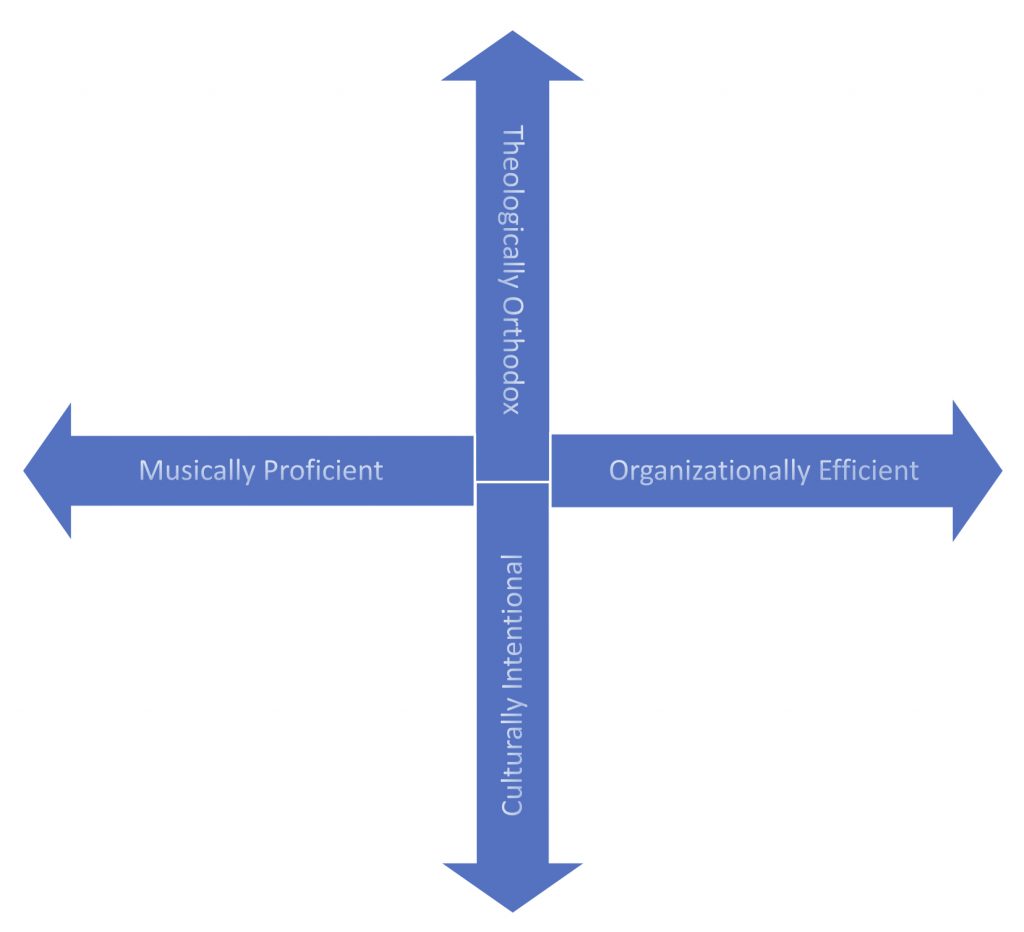
When I started my work on worship studies over thirty years ago, the expectations for worship leaders were dramatically changing. Fast forward to 2020 and the issues are the same but magnified. This is a model for discussion about expectations and needs. Truthfully, the model can be modified to serve a discussion for any role in ministry. For worship leaders, life gets exponentially more complicated when the musician is asked to coordinate all creative arts. While the artistic personality can often create and direct dramas, monologues, music etc., the larger the organization the more likely these roles will be filled by more than one person. Frustration and conflict often arise when a person is hired because of strength in one area but falls short in one of the other three. Often the other three focuses may not have been considered carefully in the hiring process. Each area is critical in the role of church ministry. This is the result of extensive work in my directed reading as part of my MA in church leadership with a focus on worship studies from Vanguard University in Costa Mesa, CA. I have narrowed the focus of a decade of discussion into eight words–along with some explanation, of course.
Theologically Orthodox—The Role of Pastor, Teacher & Theologian
This model is built on two continuums. We often think of worship as a vertical experience. In this model, the vertical continuum is living out the tensions between a well-developed theology of worship and the people we serve. We anticipate the worship leader to have a pastor’s heart. He or she should be able to choose songs and music that help fulfill the role of “teaching and admonishing each other with psalms, hymns and spiritual songs.” This process of choosing songs that are to God, about God and about our experience with God requires one who is thoughtful and intentional. One must be an educator to communicate the “why?” (If the senior pastor is strong in this area, it makes it easier for a worship leader to serve in the other areas.) What we believe in our theology will often form our response to culture. A worship leader cannot simply pick the songs they like to sing, but he or she must choose songs that provide the best opportunity for spiritual formation and participation within the congregation. Unfortunately, lead pastors who work from solely from a business model or see the music as a “warm-up” for the spoken event often miss the mark entirely.
Culturally Intentional—The Role of Sociologist (or marketing team)
Many buzz words have been used to discuss the church’s connection to the community it serves. Words like “relevant” have been the focus of magazines and books. I have chosen to use “culturally intentional.” This is where the sociologist needs to understand the community a church is trying to reach. The belief system will inform whether or not we stay with a traditional liturgical model and expect Christ to transform or transcend culture. This can be intentional. While in other systems, tradition is thrown out altogether and leaders will use every tool at their disposal to get people in the door. A full understanding of the church’s mission paves the way for discussion on how a worship leader should approach a service of worship. A close friend uses the term “missional” to describe their approach to culture. I like this, it would be closest to my preferences.
Musically Proficient—The Role of Artist/Musician
The other part of this continuum is a horizontal one. This helps us understand the role worship leaders play in relationship from the artist to the other musicians/artists in the community. An analysis of most worship leader job descriptions reveals a focus on musical proficiency. The leader must be able to sing, play a variety of instruments, create new songs, arrange other songs and be a strong performer. In the modern environment of technical productions, the artist must also be competent with a variety of technologies. We want someone who understands sound reinforcement, lighting design, and audio-visual connections. The music itself requires proficiency with a variety of performance enhancing software to raise recording and production standards. (One recent job posting that I reviewed had a list of proficiencies for software that was almost a page long.) The artist personality engages most of these areas on some level, but the expected production tools are time consuming. This leaves little time/effort to be invested in the other parts of the model.
Organizationally Efficient—The Role of Administrator/Educator
The typical artist personality often struggles in the fourth part of the model. To be organizationally efficient, a worship leader must be a strong administrator and educator. Historically, the church has been at the forefront of music education. Can the artist who is musically proficient, communicate musical concepts and train a team of musicians to work together and play off of the same page? Significant interpersonal skills are needed to work with a variety of other artists (personalities) and support personnel to produce an intentional service. These tasks require great organization skills, communication skills—both written and verbal, as well as the ability to motivate and encourage a number of volunteers.
I would love to start a conversation with you regarding music, art and/or worship. Contact me and I will get back to you.